

Trusted by:
University of Southern California
Warner Bros.
Volvo
Amazon
Stanford University
Updated: September 24, 2026
6 min read
Microcredentials in higher education blur the line between what central policy decides and what a department may do. Here's how a university microcredential policy divides governance from credential operations, in an editable kit your committee can fill in.
Research with AI:
Two departments at the same university can issue microcredentials that look identical but mean completely different things.
One goes through a curriculum committee and sits in the student information system, while the other is built in an afternoon and lives in a spreadsheet. Yet, both carry the university's name.
Governing microcredentials in higher education means answering the question a university’s microcredential policy must settle: who has authority to decide what, and who has to be told afterward?
Use the free university microcredential governance kit below to assign that authority across your multi-unit educational institution. The kit includes a RACI table, approval gates by credential type, a minimum-data worksheet, a lifecycle with exception routing, a one-page issuance handoff, and an annual review sheet.
TL;DR
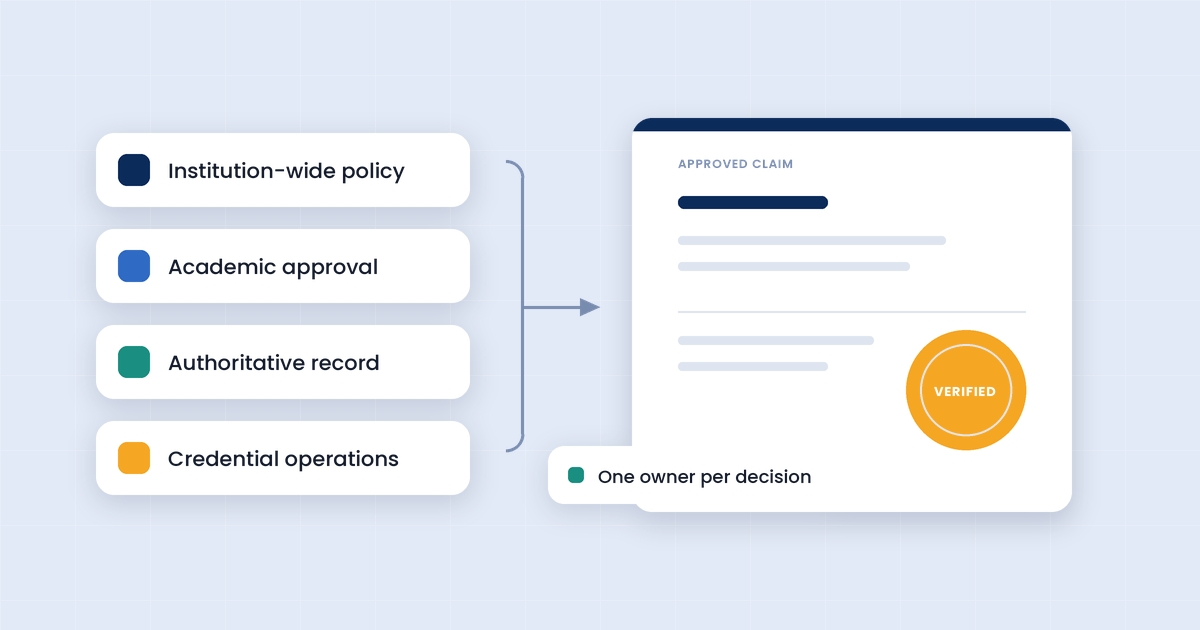
Split microcredential governance into four separate decision levels: institution-wide policy, academic or program approval, authoritative record ownership, and credential operations.
Every decision needs one accountable owner and one written trigger that returns it to approval.
Approve the claim before the template gets built to avoid unresolved academic, record, accessibility, and privacy decisions being made silently.
Every public credential field should trace back to an authoritative source and a named owner.
Treat a platform role as permission to execute, not proof of academic authority.

Centralize the rules and exceptions that make the institutional claim credible. Delegate bounded administration only after the claim, the source record, and the escalation conditions are approved.
The centralized vs. decentralized discussion forces one answer onto four separate decisions.
Function | What It Decides | Where It Usually Sits | What It Must Never Be Confused With |
|---|---|---|---|
Institutional policy authority | What may be called an official university microcredential, naming and brand rules, the accessibility floor, privacy and retention rules | Provost's office, academic affairs, or a designated senior officer | Approval of any individual program |
Academic or program approval authority | Outcomes, assessment evidence, credit status, who may earn a specific claim | Faculty governance, curriculum committee, graduate council, or a named non-credit review group | A decision the issuing unit can make alone |
Authoritative record ownership | Which system answers "did this person earn this?" and controls eligibility | Registrar and SIS for credit; CE registration system, LMS gradebook, or a designated unit record for non-credit | The credential platform's copy of the data |
Credential operations | Building the template, loading the approved cohort, sending, resending, correcting within a defined boundary | Continuing education, credential operations, a faculty administrator, or a program coordinator | Authority to change the claim being made |
01Institution-Wide Policy and Brand Rules
02Academic or Program Approval
03Authoritative Records
04Credential Operations

- copywriting
- B2B content marketing
- content strategy
- on-page SEO
- storytelling
Growth Marketer (Freelance)
Anita Coltuneac is a freelance B2B SaaS marketer with 5+ years helping tech companies grow organic visibility, build authority, and support pipeline. She uses storytelling to turn product expertise into useful content.


