Forklift Operator Evaluation Form Templates
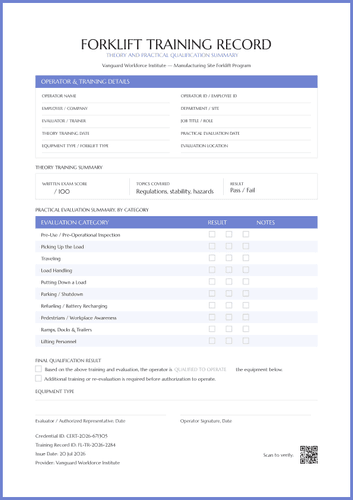
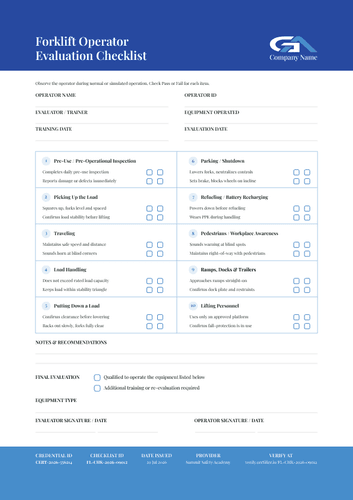
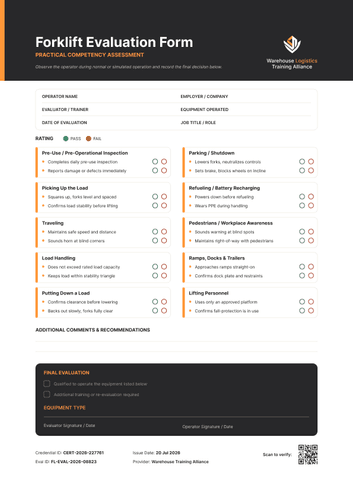
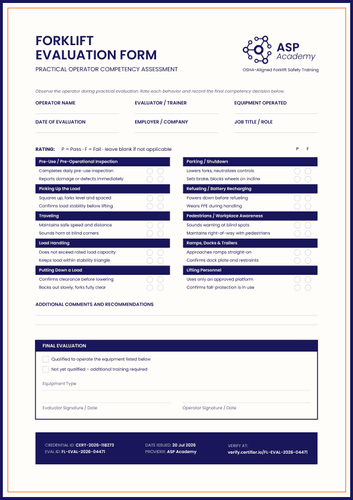
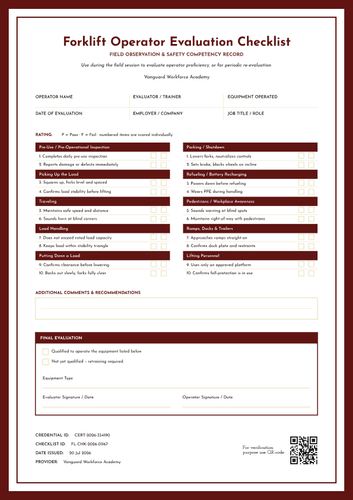
Rate each operator behavior by category with these free forklift operator evaluation form templates, then mark it pass or fail. Each template covers ten categories and around twenty individual checks, records the evaluator and operator, and ends in a qualified or not-yet-qualified result.
Personalize the chosen design, then generate a signed evaluation for every operator at the end of each observation or recheck. Import the list of operators from a spreadsheet or one of Certifier's integrations, email each record, and host a verification page a safety trainer, employer, or compliance team can check.
Rate each operator behavior by category with these free forklift operator evaluation form templates, then mark it pass or fail. Each template covers ten categories and around twenty individual checks, records the evaluator and operator, and ends in a qualified or not-yet-qualified result.
Personalize the chosen design, then generate a signed evaluation for every operator at the end of each observation or recheck. Import the list of operators from a spreadsheet or one of Certifier's integrations, email each record, and host a verification page a safety trainer, employer, or compliance team can check.
Read more
Forklift Operator Evaluation Form Templates FAQs
An evaluation is a formal, one-time assessment of whether an operator is qualified to run a specific type of equipment, recorded as qualified or not-yet-qualified. A routine safety checklist is a recurring, item-by-item check, like a pre-shift equipment inspection, confirming steps were completed rather than judging the operator's competence.
In short, use an evaluation to certify a person or use a checklist to log a recurring check.
Certifier's forklift evaluation templates record a qualified or not-yet-qualified outcome rather than a numeric score, so they're built more as a pass record than a graded ranking. You can still reissue and keep every evaluation on file for a given operator, which gives a supervisor a history to review even without a point scale.
Certifier doesn't pick a schedule for you, but it can enforce whatever schedule your program follows. On Professional and Advanced plans, turn on expiration in the evaluation's Advanced Settings and set the interval. Many organizations use OSHA's standard of reevaluating an operator at least once every three years and sooner after an accident, a near miss, or a move to a new type of truck.
Yes. The checklist items are editable fields rather than a fixed layout tied to one truck class, so you can swap in the checks relevant to each type of equipment from the same base template instead of maintaining a separate design per class.