

Trusted by:
University of Southern California
Warner Bros.
Volvo
Amazon
Stanford University
July 03, 2026
12 min read
Need to prove a credentialing program pays for itself before finance signs off? Here's how to model the ROI of digital credentials honestly, with the value levers and a cost-aware formula you can run on your own numbers.
Research with AI:
The ROI of digital credentials comes from a short list of levers, like saved administrative time and avoided verification costs on the hard side, plus engagement and reach on the softer side.
None of it counts as return until you can tie it to realized savings or attributable revenue. The honest answer is that ROI is organization-specific and positive only when operational savings and attributable value cover the full cost.
This guide covers the value levers and the cost picture, then gives you a model to run the numbers yourself.
Digital credentials ROI comes mainly from lower administrative and verification costs, plus avoided printing and reissue overhead.
Engagement and marketing reach add value, but they count as ROI only when tied to measurable savings or attributable revenue.
A credible calculation includes the full cost of ownership, not just the platform subscription.
Measure it on your own baseline: ROI % = (quantified benefits - total costs) / total costs x 100.
Build more than one scenario instead of a single optimistic number, and prioritize the assumption that actually changes the decision.

Before you calculate anything, separate what genuinely belongs in an ROI figure from what doesn't. This is where most credential business cases lose finance: they fold engagement and shares into "return," and the number becomes indefensible.
Sort every expected outcome into one of four buckets, by how confidently you can put a dollar value on it.
Value Type | Counts In The Roi Figure | Examples |
|---|---|---|
Hard savings | Yes | Redeployable admin time, printing and mailing |
Attributable financial value | Yes, if attribution is documented | Added enrollments or renewals tied to the program |
Risk-adjusted value | Only as an expected value | Lower expected losses from credential fraud |
Directional value | No, until you can price it | Engagement and brand reach |
Hard savings and documented attributable value go straight into the calculation. Risk-adjusted value belongs in only as an expected figure, and directional value stays out of the formula until you have a method to price it.
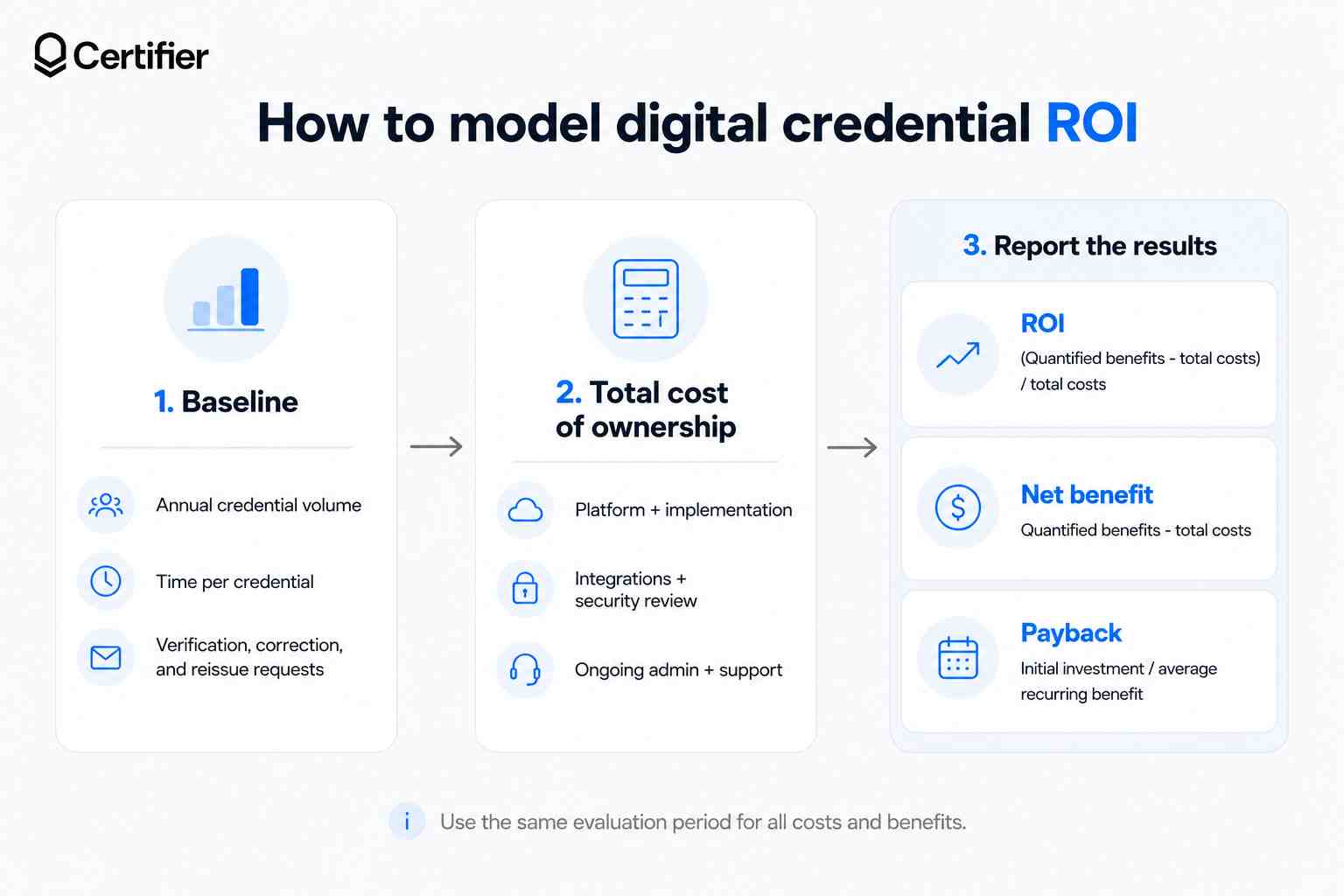
Three numbers answer different questions, so report all three. Net benefit is the raw dollars left after costs. ROI expresses that as a percentage of what you spent. Payback period tells leadership how long until the program recovers its initial cost.
Keep every cost and benefit on the same evaluation period, or the comparison breaks.
Finally, don't confuse program metrics with financial return. Metrics like credential views and social shares show whether a program is working.
Tools that surface credential analytics make those signals visible, but a view becomes ROI only once you can connect it to a saved cost or an attributable conversion.
The return lives in a handful of levers, hard levers first, since those are the ones finance accepts without a fight. If you want the underlying definitions before going further, the primer on what digital credentials are covers the types and the basic operating model.
The biggest hard lever is administrative time. Manual credentialing means creating certificates one by one and distributing them by hand. Bulk generation and automated issuance replace that with a single upload or an event trigger, and managed email delivery handles the send.
You can automate credential issuance through native integrations or an API, so it no longer consumes staff hours.
Don't bank the full hourly cost of every hour removed, though. Convert hours to value only after applying your loaded hourly cost and a realization factor, which the model below explains.
Real-life examples: Wibo reportedly took a 90-person certificate job from roughly a day to under ten minutes with bulk upload.
Carousel Child Advocacy Center reported a similar shift on a 150-person run, from about a week to effectively immediate, with the freed staff time going back into outreach. These are individual customer-reported outcomes, not benchmarks to expect.
Two different things hide under "verification." Verification savings are the staff hours you stop spending answering "is this real?" requests, because a public verification page and a QR check let third parties confirm a credential themselves.
That's a hard saving. Fraud-risk reduction is separate: it's the expected value of making credentials harder to forge, and it belongs in the model only as a risk-adjusted figure.
For the mechanics, see how verifiable digital credentials work.
Manual processes generate mistakes, like a misspelled name or a resend that shouldn't have been needed.
Credential templates with mapped recipient data and centralized management cut the correction load, which shows up as recovered admin time rather than a separate budget line.
Going digital removes physical line items like printing and postage. The storage and replacement costs that paper credentials carry disappear too.
Real-life example: CHEC, running 300+ attendees per cycle, reported lower printing and admin costs after going digital. Audit retrieval also got easier when verification queries came in.
Keep these avoided physical costs separate from digital reissues, which cost almost nothing once the workflow exists.
Recognition has real effects on employee development and retention, and an employee recognition program built on credentials gives people a way to signal a skill or a milestone.
These are genuine benefits of digital badges, but they're directional value: keep them out of the ROI figure unless you have a documented way to price retention or engagement.
Skill signaling through micro-credentials can also support internal mobility and broader employee development, which is worth tracking even before it's monetized.
Shared credentials put your brand in front of new audiences, but that exposure is not automatically financial return. A social post first creates reach.
It becomes attributable value only when the organization can follow the recipient’s activity from the shared credential to a measurable business outcome.
The attribution path looks like this:
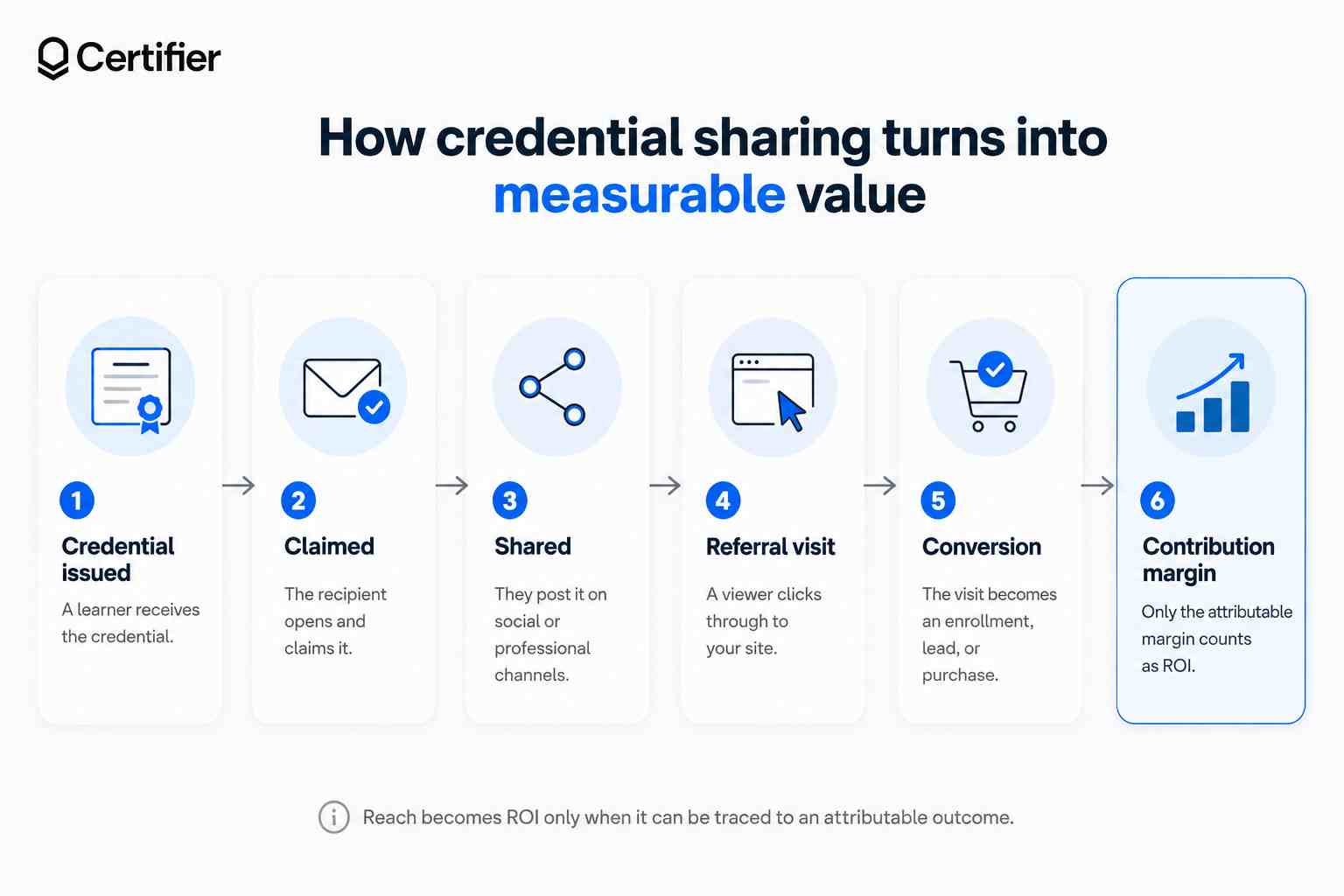
Each stage answers a different question:
Claim and share rates show whether recipients engage with the credential. Referral visits show whether those shares bring people to your website. A completed enrollment, purchase or qualified lead connects that traffic to a business result.
Only then can the organization calculate financial value based on the contribution margin generated by the conversion, not the total revenue alone.
Real-life example: When Koddi Academy saw strong social-share results from its issued credentials, that was real reach, but it remained a program metric until a share could be traced to a conversion.
Because the full measurement framework is its own topic, the deep dive lives in the marketing ROI of digital credentials.
A credible cost-benefit analysis includes the full cost of ownership. Platform cost is the obvious part: a subscription plus any volume-based fees as issuance grows.
A breakdown of digital credentialing costs shows how that scales with volume. Your choice of digital credentials platform shapes most of these inputs, and the digital credential service provider you pick determines how much is bundled by default.
Beyond the subscription, a full picture includes:

Initial setup and implementation: configuring the workspace and templates.
Integrations or automation: native connectors and no-code workflows are cheap, while custom API builds carry developer hours.
Data preparation: cleaning and mapping recipient records.
Design and metadata: building the credential and its earning criteria.
Security and procurement review: privacy checks and vendor assessment.
Training and change management: getting teams and recipients on board.
Ongoing governance and support: maintenance and help requests over time.
Costs are concentrated in custom development and migration, not in everyday issuance. Native integrations and no-code paths keep implementation light, while heavy API projects push it up.
For programs at that scale, enterprise digital credential requirements like security and governance also affect the total cost of ownership.
Now the model. Start from your own baseline, so the case is auditable. Before any formula, gather the current-state numbers:

Annual credential volume
Processing time per credential
Error and correction rates
Printing and delivery spend
Replacement and verification requests
Support tickets and record-retrieval time
Current software and staff or contractor costs
These ground the calculation in what credentialing costs you today. With a baseline and a cost total, compute three figures over a single evaluation period. The standard ROI formula is straightforward:
ROI % = (Total quantified benefits - Total costs) / Total costs x 100
Net benefit is simpler still, the dollars left over:
Net benefit = Total quantified benefits - Total costs
And payback shows how fast the program repays its setup:
Payback period = Initial investment / Average recurring financial benefit
ROI and payback answer different leadership questions, so present both rather than picking the flattering one.
Here's where most calculators overstate. They multiply every saved hour by an hourly cost, as if removing an hour automatically returns cash. It doesn't.
Apply a realization factor for how much freed capacity becomes real economic value:
Captured labor value = Hours eliminated x Loaded hourly cost x Realization factor
Saved time counts when it avoids a new hire or redirects staff to higher-value work, not when it just spreads thinner across the same team.
A six-person team like A Kind Life said the time it saved went toward more personalized client service. This shows the realization factor in action: freed capacity was redirected to higher-value work.
Replace a single optimistic number with separate scenarios, each with its own assumptions and its own ROI and payback.
Conservative: documented hard savings only, the number finance can't argue with.
Base: hard savings plus attributable value you can defend with your own data.
Upside: adds risk-adjusted and marketing value, but only where program data supports it.
Ground the inputs in real time savings where you can. For the per-credential time input, IMG4IMGS reported saving roughly one to two minutes per certificate, so you can multiply your own volume by a figure in that range, then run it through the captured-value formula above.
As an illustration only, not a benchmark: suppose a team spends 12,000 USD a year on a platform and setup, and documents 20,000 USD in hard admin and printing savings.
The conservative net benefit is 8,000 USD, a 67% ROI, with payback inside the first year. A base case that adds defensible attributable value would lift both figures, and an upside case that prices in reach would lift them further.
Swap in your own numbers, since the result is specific to your volume and process. Then prioritize measuring the one assumption that would flip the decision, instead of refining numbers that don't change the outcome.
ROI isn't one team's win. It's worth mapping who absorbs the cost and who sees the value, because that mapping doubles as your measurement plan.
Team | What They Own And Measure |
|---|---|
L&D or credential operations | Issuance time and corrections |
IT and security | Integrations and access controls |
Recipient support or registrar | Resends and verification requests |
Compliance and audit | Evidence retrieval and record integrity |
Marketing | Referral traffic and attributable conversions |
Finance | Total cost of ownership and ROI |
Once each team owns a number, the business case stops being an abstract claim and becomes something the organization can verify after launch.
Positive ROI depends on conditions you can check before you commit. The return tends to be strong when:
Issuance volume is high
The current process is labor-intensive or paper-heavy
Verification and support requests are frequent
Automation coverage and recipient adoption are both high
It's weak or delayed when:
Volume is low and the current process already costs little
Integrations are complex or adoption is poor
The credential has limited external recognition
That last point matters most for any hiring or job-market value. Research from UpSkill America at the Aspen Institute found employers view digital credentials positively but struggle to interpret and trust them, often unable to equate a specific credential to a specific skill or role.
So treat external recognition as an assumption to test. A credential earns market trust when the issuer is identifiable, the badge clearly states its criteria and evidence, and a trusted verification page confirms its authenticity.
Certifier doesn't guarantee positive ROI. What it does is change the inputs in the model, and it's worth being specific about which ones.
In the conservative case, bulk issuance and managed credential emails reduce manual creation and distribution work, and the avoidance of printing or physical replacements drops out of the budget.
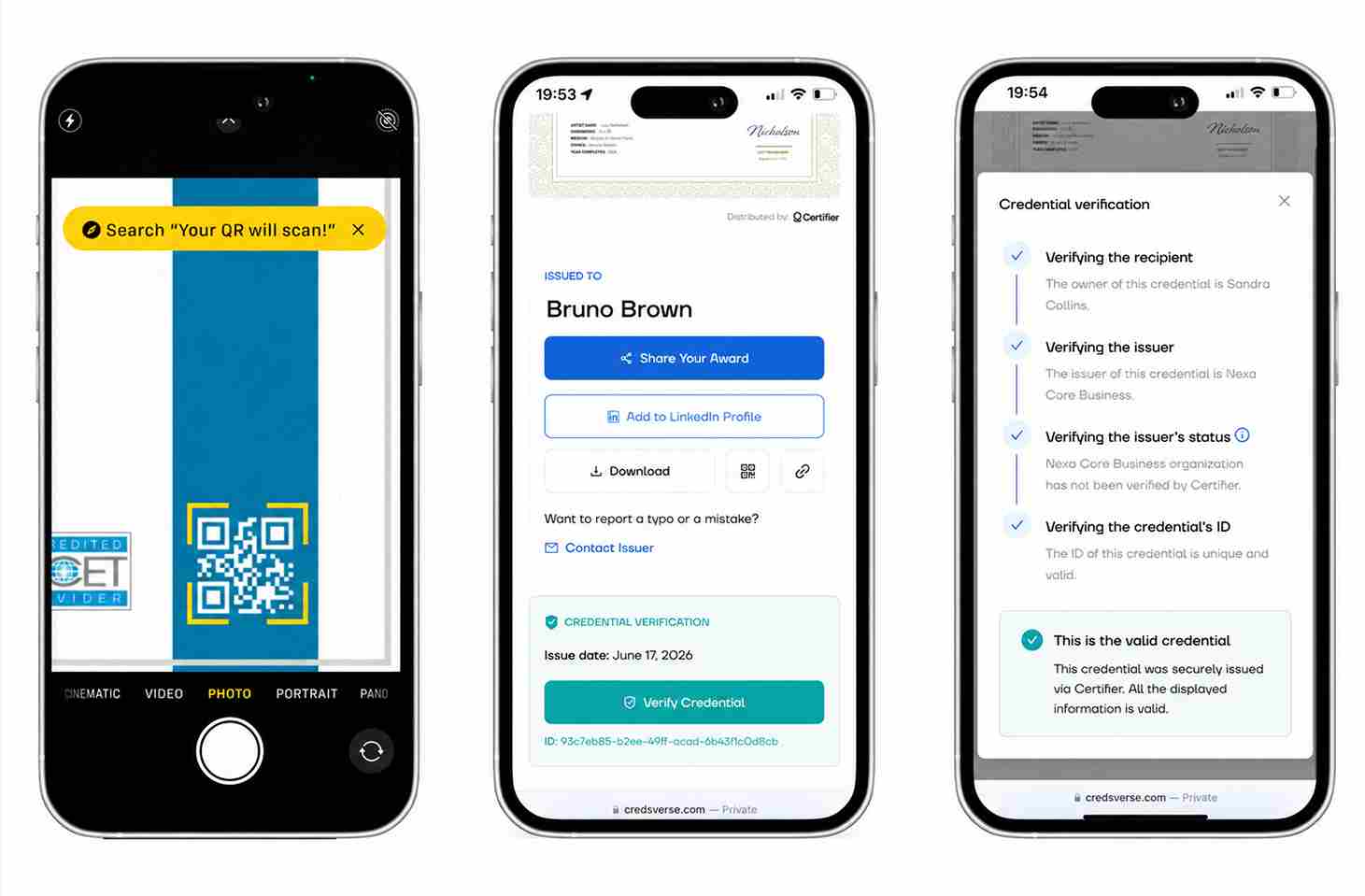
Public verification pages let recipients and third parties self-serve, which trims routine resend and verification requests.
In the base case, add savings your own data supports, like fewer corrections and a lighter support load as repeatable workflows take hold.
QR code verification, available on the Professional plan and higher, reduces measurable verification effort where you use it. Apply a realization factor here too, so only the portion of saved time that creates economic value is counted.
In the upside case, add value that becomes attributable after launch, such as higher automation coverage or measurable marketing contribution along the attribution path. Keep views and shares outside the figure until they connect to an outcome.
On the cost side, Certifier runs on a free-to-enterprise pricing model, so the platform input scales with your volume rather than a fixed enterprise minimum.
See Certifier pricing to slot a real number into the model. For a program with custom integration or security scoping, booking a demo is the fastest way to estimate implementation costs before you pitch leadership.
None of this is guaranteed, though. The point of the three cases is that Certifier shifts the inputs, while your volume and adoption decide the output.
The ROI of digital credentials is real, but it's levered. It shows up when a labor-heavy, paper-bound process gets automated, and it stays honest when you keep directional value out of the formula until you can price it.
Build your baseline, model more than one scenario around a defensible base case, and let the assumption that would flip the decision guide what you measure first. Do that, and the case makes itself to finance, no inflated benchmarks required.

- Content Strategy
- SEO & AEO/GEO strategy
- Conversion Rate Optimization
- Organic Growth
- Buyer Psychology
Head of Content
Vlad Melnic leads content at Certifier, bringing 10+ years of experience in SEO content marketing and conversion-focused content. His focus is turning complex product value into clear benefits.
ROI: Return on Investment Meaning and Calculation Formulas – Investopedia
https://www.investopedia.com/articles/basics/10/guide-to-calculating-roi.aspEmployer Insights on Digital Credentials and Skills Profiles: Lessons Learned – Aspen Institute
https://www.aspeninstitute.org/publications/employer-insights-on-digital-credentials-and-skills-profiles-lessons-learned/Payback Period: Definition, Formula, and Calculation – Investopedia
https://www.investopedia.com/terms/p/paybackperiod.aspEverything to Know About ROI, TCO, NPV, and Payback – Nucleus Research
https://nucleusresearch.com/everything-to-know-about-roi-tco-npv-and-payback/