

Trusted by:
University of Southern California
Warner Bros.
Volvo
Amazon
Stanford University
Updated: September 11, 2026
5 min read
Putting together a stackable microcredential pathway is less a design problem than an administration one. This guide covers the four rules the pathway needs, where each one has to be enforced, and the system constraints that decide whether your design holds up once you build it.
Research with AI:
Learners finish the path they can see themselves advancing through.
That’s where stackable microcredentials come in to give credentials an order and a specific award at the end. Each completion becomes a reason to come back for the next one.
However, that only holds if the connections between these microcredentials live somewhere other than your mind. Otherwise, a learner who finished three of your eight courses in 2023 can ask what it adds up to and they won’t be able to get an answer.
Your job is to turn separate badges into a pathway your learners and your institution can both understand and administer, year after year.
It takes four rules: what counts, in what order, how much is enough, and how long a completion stays valid.
This guide covers what each rule has to specify, where each one has to be enforced, and the four constraints that decide whether your pathway design works in a credential platform like Certifier.
By the end, you can fill in a rule table and hand it to whoever signs it off.
TL;DR
A stackable microcredential pathway needs four rules written down: what counts, in what order, how much is enough, and how long a completion stays valid.
Credential platforms record what learners earned, but they don’t control who may enroll. Certifier issues the completion credential once all criteria are met, in any order, so a course that genuinely must come first has to be gated in your registration process or your LMS.
One pathway produces one completion credential. Three exit awards means three pathway objects sharing the same components, not one branching pathway.
Activating a pathway issues completion credentials retroactively to everyone who already qualifies, including alumni who studied before it existed.
Credentials expire independently, so a completion award stays valid after its components lapse unless you give the award its own expiration date.
Pathways is an Advanced-plan feature in Certifier.

According to UPCEA's 2026 State of Continuing Education report, 88% of professional and continuing education units currently offer microcredentials to their learners while administrative burden is listed as one of the top barriers to expanding them further.
To address that challenge you need to plan your learning pathway. There are four questions that turn a set of microcredential badges into a learning pathway you can easily manage.
Answer them for your own program and you have a specification you can take to a committee.

What counts: Split your components into a required core and an elective pool, then name the minimum number of electives. Resist making everything required since that removes the flexibility that made stacking worth doing in the first place. Decide too what counts from outside your program: prior learning, another provider's credential, an industry certification.
How much is enough: Express the threshold as something countable, such as credits, hours, or a number of credentials. For example, the EU's 2022 framework treats notional workload, ideally in ECTS credits, as a standard element of a credible micro-credential.
How long it stays valid: This is the rule most programs skip, generating more one-off judgment calls than the other three combined. Set an explicit recency window. For CPD, align it to the renewal cycle you already run. If practitioners renew annually, a component completed four years ago probably shouldn’t carry the same weight as one completed last spring.
Where each rule is enforced: Write the enforcing system beside each rule. A rule nobody checks is a preference and the difference only shows the day a learner tests it.
Here’s how the rules above would help create a stackable microcredential pathway for a five-course marketing track with annual renewal:
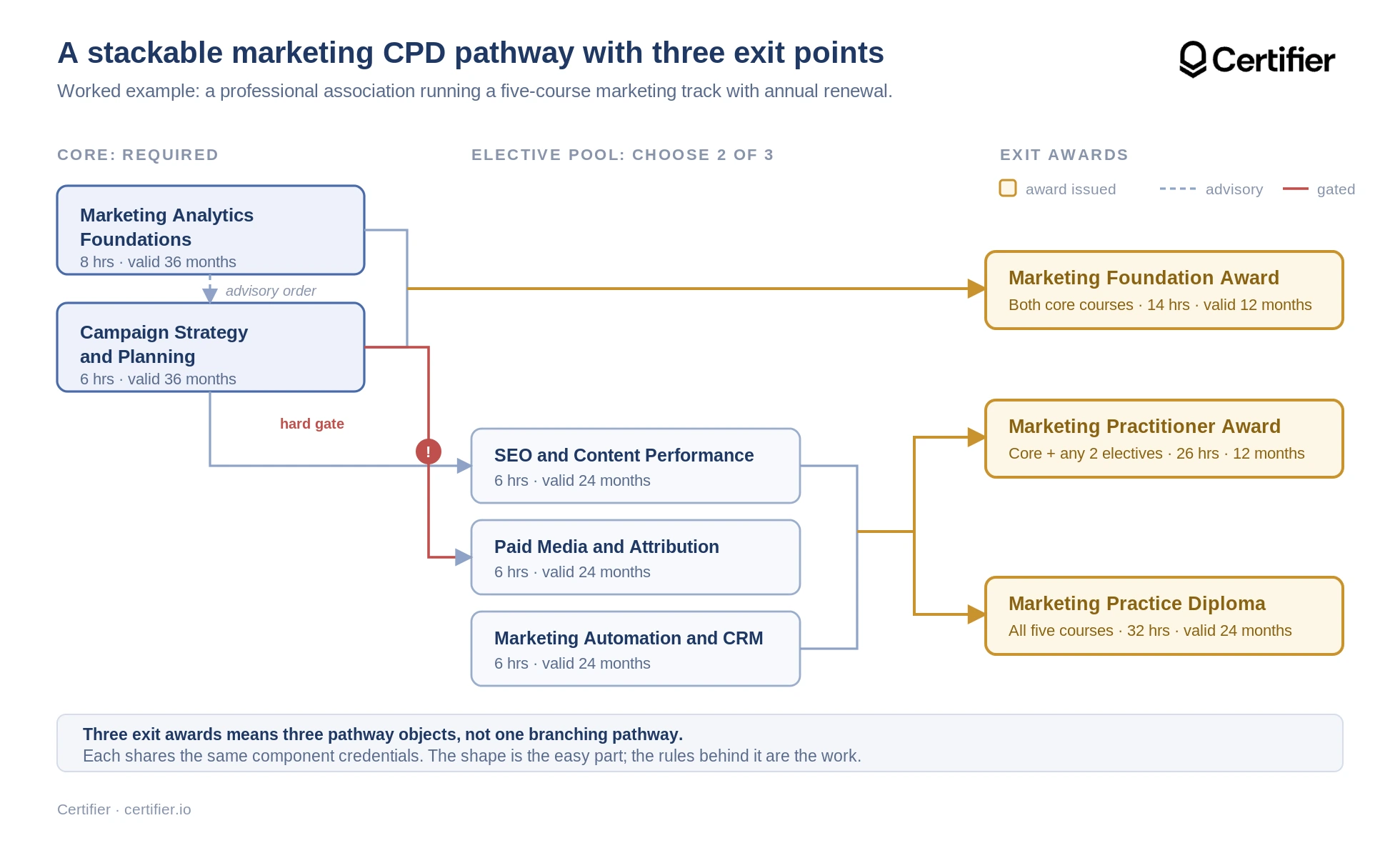
The two core courses feed every award. No award is reachable without them.
The elective pool feeds Practitioner and Diploma, never Foundation. Electives alone don’t add up to an award.
The dashed line is advisory. Analytics before Campaign Strategy is a recommendation and nothing stops a learner reversing the order.
The solid red line is the program's one real gate. Paid Media assumes Campaign Strategy, so that one is enforced at registration.
Each award has its own arrow because each is a separate pathway, sharing the same course credentials rather than branching off one. That constraint decides how many exits you can model.
This is the step where most stackable micro credentials designs quietly break. Your registration system, your LMS, and your credential platform each know something the others don’t. Meanwhile, a prerequisite falls into the gap between them.
Start from what each one can actually do. Your credential platform records what a learner earned but it doesn’t control who may enroll.
In Certifier, you can arrange a pathway's criteria credentials in a logical order, but that order is just presentation. Completion is evaluated on criteria met, not order followed.
A learner who takes your advanced course first and your foundation course last earns the completion award exactly the same as one who followed your sequence.
So if Course B genuinely requires Course A, that gate has to live somewhere that can actually refuse a learner. There are three places and only one of them stops anybody:
Layer | What It Controls |
|---|---|
Registration | Who is allowed to enroll |
LMS | Which content opens up |
Credential layer | What was earned. Recorded, not gated |
A program assumes its credential platform enforces the sequence; it doesn’t. Learners take the advanced course first, earn every required credential, and receive an award nobody meant to grant them.
Six months later an employer asks how someone holds an advanced credential without the prerequisite and the rule turns out to have lived only in a planning document. That assumption is riskier in continuing education than in most sectors.
The same UPCEA report found that only 27% of continuing education units say their technology integrates fully with main campus systems. If fewer than three in ten units have systems that talk to each other, "the platform will handle it" is not a safe assumption about any gate.
The practical fix takes ten minutes. For each prerequisite, decide two things: is it hard (a learner cannot start without it) or advisory (you recommend an order but will not block anyone) and which layer enforces it. Then check that the layer you named can do the job.
Most prerequisites work fine as advisory. If more than about a third of yours end up hard, it’s worth a second look. A stack with that many gates behaves a lot like a linear course, which gives back the flexibility you stacked for in the first place.
Work through each prerequisite and answer four questions:

Is this hard or advisory?
Which layer enforces it: registration, LMS, or neither?
Does a completion from three years ago still satisfy it?
What happens to a learner who reaches this step without it?
Every point where a learner can stop needs a named award and a countable threshold. Then comes the structural constraint that catches people out: one pathway produces one completion credential.
A CPD ladder with a Foundation award, a Practitioner award, and a full Diploma isn’t one pathway that branches but three pathway objects, each with its own criteria and its own completion credential.
What makes that workable is that a single microcredential can serve as criteria in more than one pathway, so your two core courses feed all three awards without being duplicated.
So count your exits before you build. Three exits means three objects to create, activate, and maintain. Certifier’s Advanced plan allows up to 5 pathways per account by default, which covers most programs.
For the CPD track above, that comes out as:
Exit Award | Threshold | Hours | Valid For |
|---|---|---|---|
Foundation Award | Both core courses | 14 | 12 months |
Practitioner Award | Both core courses + any 2 electives | 28 | 12 months |
Practice Diploma | All five courses | 32 | 24 months |
Then set the validity of each award deliberately as every credential expires on its own terms. A completion credential doesn’t track the validity of the components that earned it, so when a criteria credential lapses, the award built on top of it stays valid.
For example, the Practitioner Award a learner earned in 2024 will still be live in 2028 unless you gave that award its own expiration date.
For most programs that’s fine. For CPD, however, it’s a problem because it produces exactly the outcome the renewal cycle exists to prevent: a practitioner holding a current-looking award whose underlying training all expired years ago.
If your award is meant to represent current competence, put an expiration date on the award itself and set it to your renewal cycle. Credential expiration rules with automated reminders require Certifier’s Professional plan or above.
Create and Send Digital Credentials

Activating a stackable microcredential pathway is above all else an issuing event. This means that the moment a pathway goes live, every learner who already meets the criteria will receive the completion credential.
For a provider with years of back catalog, that can mean hundreds of awards going out at once to alumni who never enrolled in a pathway that didn’t exist when they studied.
Every credential in a pathway draws on your annual allowance, the criteria credentials and the auto-issued completion credential alike.
So, a pathway with 3 criteria and 1 completion credential costs 4 credits for each recipient who finishes it. Run that against your back catalog before you activate the pathway.
For example, 200 qualifying alumni is 200 completion credits leaving your allowance on the day you switch it on. Anything beyond your limit is created as a draft in Certifier rather than issued.
Here are three questions you need to settle before you activate a pathway:
Do you want the back catalog included or should this pathway start clean?
Does your remaining credential allowance cover the retroactive issuance?
Would you be comfortable with a 2019 alum receiving this award, unannounced, on a random Tuesday morning?
Get the rules right first as editing a pathway after activation can change who qualifies and reset progress indicators.
You already have most of what a stackable microcredential pathway needs. The courses exist, the badges are going out, and learners are earning them.
What is missing is four decisions nobody has written down (yet) and a note beside each one naming the system that will enforce it. Make those decisions and the questions that used to need a meeting answer themselves.
The learner who finished three courses in 2023 gets a straight answer because the recency window says so. The alumni who qualify the day you activate get their award on purpose rather than by surprise.
And the award that would have outlived its components doesn’t because you gave it an expiration date of its own.
If you’re new to digital credentials, sign up for a free Certifier account to generate your first course credentials while the pathway rules are fresh in your mind.

- copywriting
- B2B content marketing
- content strategy
- on-page SEO
- storytelling
Growth Marketer (Freelance)
Anita Coltuneac is a freelance B2B SaaS marketer with 5+ years helping tech companies grow organic visibility, build authority, and support pipeline. She uses storytelling to turn product expertise into useful content.