
Trusted by:
University of Southern California
Warner Bros.
Volvo
Amazon
Stanford University
Updated: September 15, 2026
10 min read
Higher education teams don't need just any tool. This guide compares the best digital credential platforms for higher education by use case, from microcredentials to diplomas.
Research with AI:
Higher education teams rarely need "a credentialing platform" in the abstract. They need the right one for a specific job.
Microcredentials call for learning pathways and cohort-scale issuance. Digital badges call for easy sharing and instant verification. Formal diplomas call for long-term trust and institutional-grade branding.
The best digital credential platforms for higher education each lean toward one of those jobs, so the smart move is matching the tool to the use case instead of chasing the longest feature list.
Below, we map the leading options to the credentialing work that matters most on campus, then walk through how to choose.
Best for micro-credentials and continuing education: Certifier – branded certificates, digital badges, bulk issuance, and analytics.
Best for employer recognition: Credly – credentials connected to a large employer-recognized badge network.
Best for LMS-driven certificate programs: Accredible – automation, integrations, and certificate workflows.
Best for diplomas and blockchain verification: BCdiploma – diploma-level verification with blockchain-backed trust.
Best for Canvas users: Parchment Digital Badges – built for the Canvas/Instructure ecosystem.
Before choosing: check LMS integrations, Open Badges support, FERPA/GDPR compliance, SSO, pricing, and credential retention policies.

A tool that works fine for a one-off webinar can be a poor fit for a graduating cohort or a formal degree.
Higher education raises the bar because credentials here touch student records and need verification that holds up years later. Before comparing platforms, it helps to know which features actually move the decision.
Start with definitions, since the words get used loosely.
→ Digital credentials cover everything from a single course badge to a blockchain-anchored diploma.
→ Microcredentials are the short, skills-based awards that sit between informal learning and a full degree.
A general-purpose digital credential management software stack might handle issuance well but still fall short on FERPA documentation or native LMS plugins, which is exactly where higher education buyers get tripped up.
Here's what tends to decide the shortlist for digital credentials in higher education:

LMS integration depth: Whether the platform connects to Canvas or Moodle through a native plugin or only through API and Zapier workflows changes how much IT involvement you'll need.
Open Badges 3.0 support: The current Open Badges 3.0 standard makes credentials portable and machine-readable. It now expresses each badge as a verifiable credential too.
FERPA and GDPR documentation: US institutions need student-data protection on record; EU partner programs need GDPR controls.
SSO and admin controls: Institutional teams want secure access and role-based permissions before procurement signs off.
Stackable credentials and pathways: Programs that build microcredentials toward a certificate need a way to link awards into a sequence.
Institutional white-labeling: The university brand should lead on the credential page and the verification email.
Verification permanence and pricing at scale: Credentials issued today should stay verifiable, and pricing should fit a small continuing-education cohort as well as a full graduating class.
One more standard worth knowing is the Comprehensive Learner Record (CLR), which packages multiple verified achievements into a single learner record. If your institution wants credentials to connect to transcripts down the line, CLR alignment belongs on the checklist.
These criteria decide the shortlist, but they don't all carry the same weight. A requirements checklist with editable weights shows how much each one should count for an extension unit versus a CE program.
Here's how the leading options stack up against the higher-ed requirements above.
Platform Best Highered Use Case Free Plan Starting Price Lms Integration Open Badges30 Whitelabel Ferpagdpr Key Caveat Certifier Microcredentials, continuing education Yes (250/yr) $0; $67/mo paid Via API, Zapier, Google Sheets Yes, applied automatically Custom domain, branded pages GDPR; ISO 27001 LMS connects via API, not deep native plugins Credly Employer-network reach No Custom quote; contract-based LMS connectors Yes (Open Badges) Limited; network branding Enterprise compliance Opaque pricing, no self-serve Accredible LMS-automated certificate programs No Annual, per recipient Native (Canvas, Moodle) Yes Higher tiers Yes Annual contract, per-recipient cost BCdiploma Formal diplomas, blockchain trust No Per recipient, enterprise LMS/SIS via API Open standards Available with White Label Pack GDPR Minimum recipient volume; custom white-label pricing Parchment Digital Badges Canvas-native institutions No Institutional licensing Native Canvas Open Badges native Within Instructure GDPR Most direct course-to-badge workflow in Canvas
The best platform depends on the credential type and your institution’s existing systems. It should also match the level of control your team needs.
Below, we compare five digital credential platforms for higher education and show which use case each one suits best.
Certifier is the most flexible and transparent option for universities and continuing-education teams building microcredential programs.
It's a strong fit when you want branded certificates and digital badges at scale without heavy IT involvement or enterprise-only procurement.
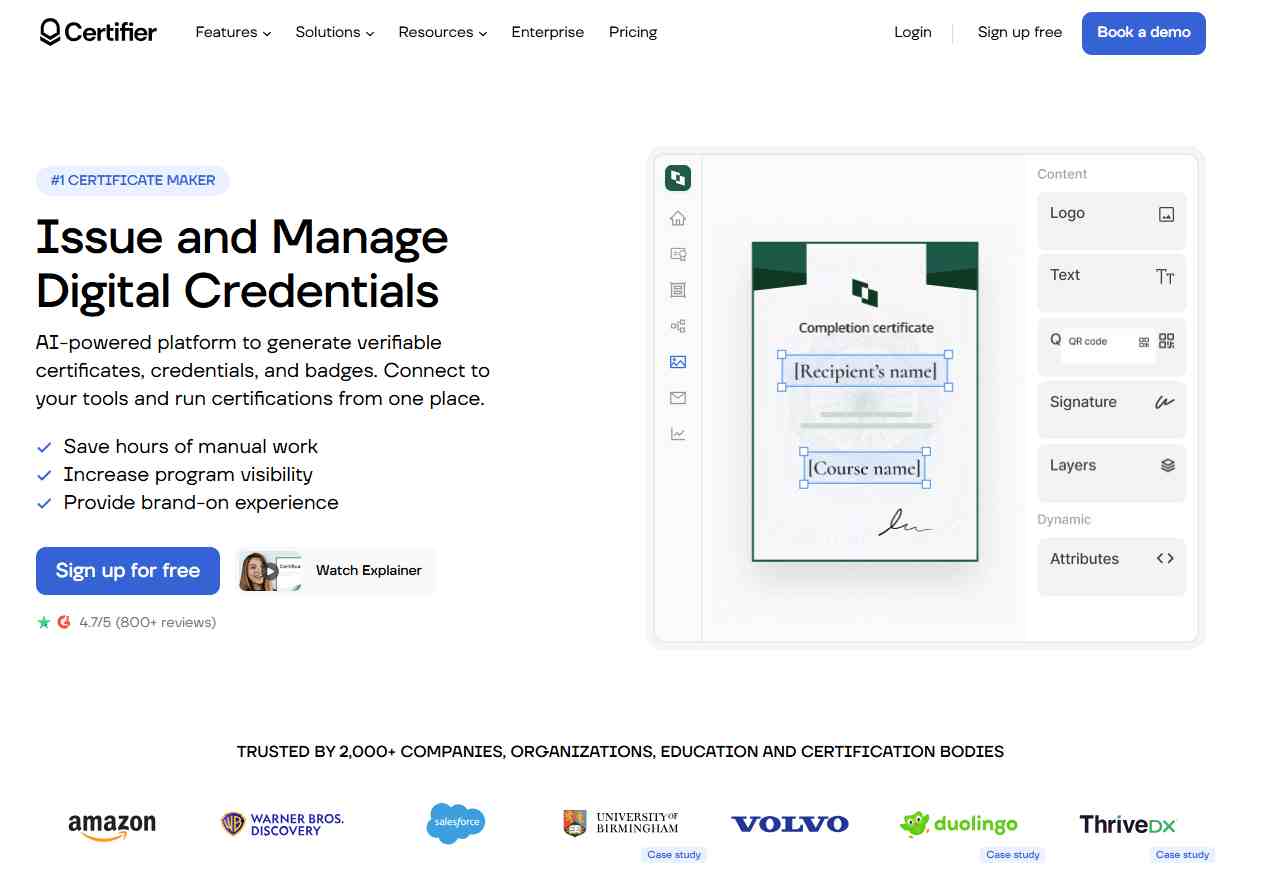
All-in-one credential management: Create and issue certificates or badges from one platform.
Bulk issuance: Upload a CSV file to send credentials to a full course cohort in minutes.
Stackable learning pathways: Connect awards through Learning Pathways to support multi-stage programs.
Verifiable credentials: Each credential includes Open Badges 3.0 metadata. It also has a QR code and a unique verification URL.
Institutional security: Certifier is GDPR compliant and ISO 27001 certified. It also supports SAML SSO through Okta or Microsoft Entra ID.
Consistent university branding: Use custom domains and branded emails to keep the institution’s identity visible.
Higher education integrations: You can connect Certifier to LMSs and other institutional systems through connectors like Zapier, API setup, native or custom integration.
There's a free plan for 250 credentials a year, the Professional plan runs $67/mo, and there's no annual lock-in or setup fee.
You can review the tiers on Certifier's pricing page and start without talking to sales.
Select the perfect plan for your needs
Best higher-ed use case: microcredentials in higher education and continuing-education programs that need clear pricing and fast setup.
Credly, part of Pearson, is built around a large public badge network where employers can discover credentialed talent.
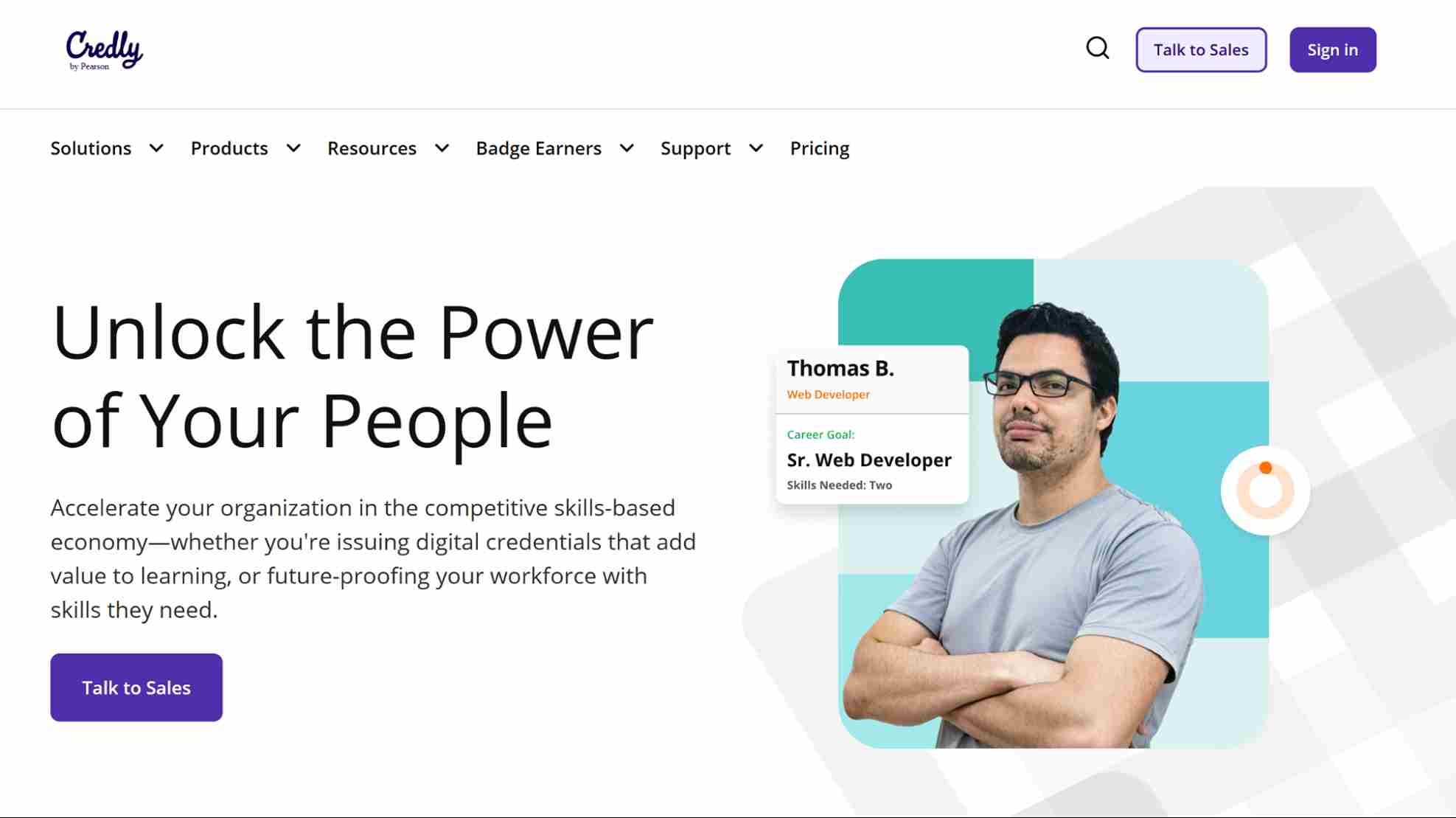
The main trade-off is Credly pricing transparency and institutional control. Credly does not publish issuer prices or offer self-serve organizational onboarding.
Institutions must contact sales, complete a legal contracting process, and receive tailored terms through an order form. Credly does not offer white-label credentials. Institutions can customize badge designs and email communications, but credentials remain within Credly’s shared platform.
That model may suit universities that value network visibility more than full control over the credential experience. For a closer head-to-head on the network-versus-flexibility question, see Accredible vs Credly.
Best higher-ed use case: institutions that want employer-facing badge discovery at scale and can commit to a sales-led contract.
Accredible is a strong option for higher education programs that rely on an LMS. Its standard integrations include Canvas and Moodle.
Institutions can connect credential issuance to course or module completion, although the exact workflow differs between LMSs.
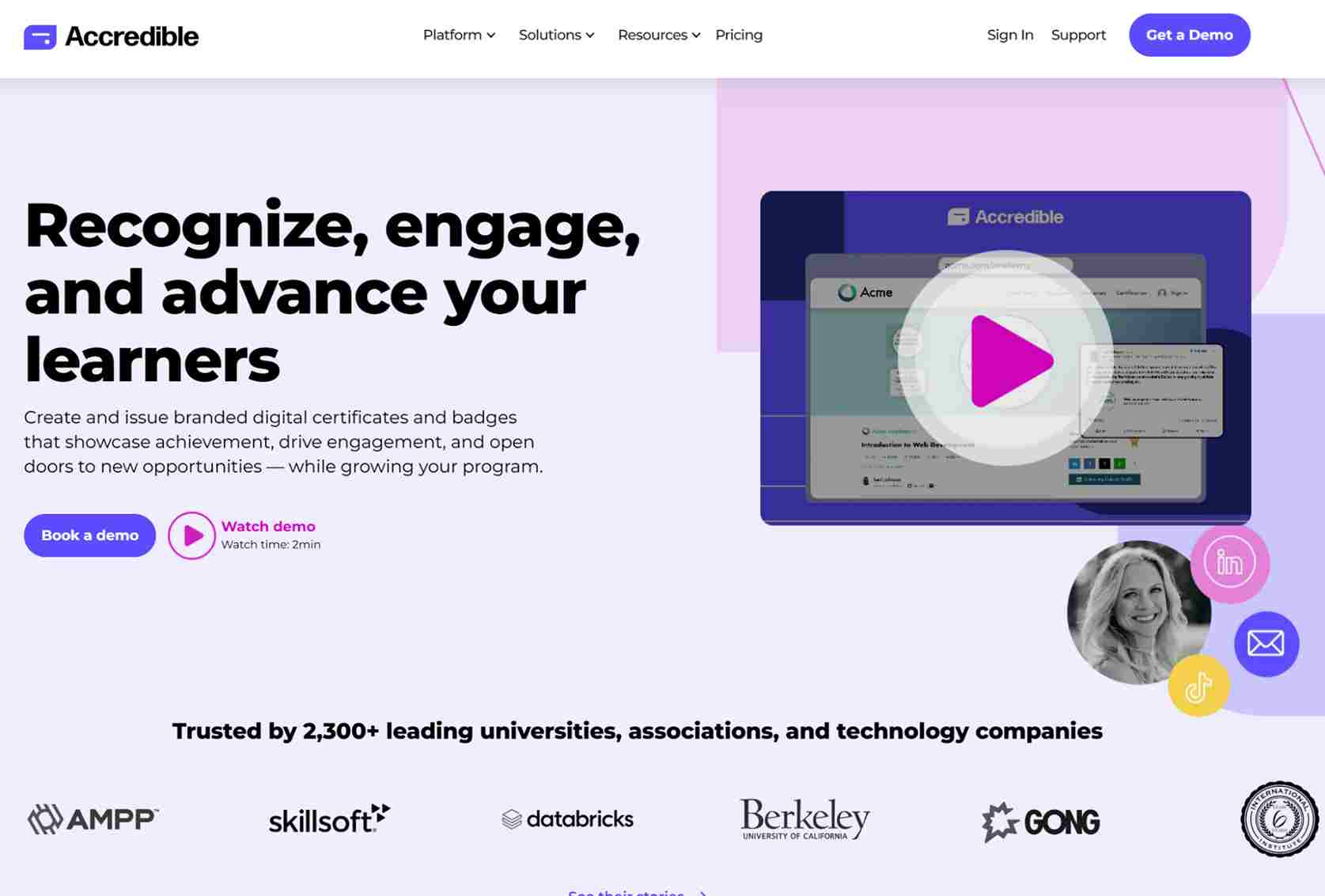
Accredible charges by unique recipient rather than by credential. Its Launch plan starts at $45 per month for 50 recipients, but it requires a 12-month term. Connect and Growth use custom pricing for larger programs.
Basic credential branding is available across the plans. More extensive brand control may require a higher tier or add-on. Advanced reporting also depends on the selected plan.
Teams that need month-to-month flexibility or a permanent free plan often weigh Accredible alternatives before committing.
Best higher-ed use case: mid-size to large universities running structured certificate programs that need deep, automated LMS issuance.
BCdiploma is an option for formal academic credentials that require long-term verification. Its technology secures credential data through blockchain and gives recipients continued access to their records.
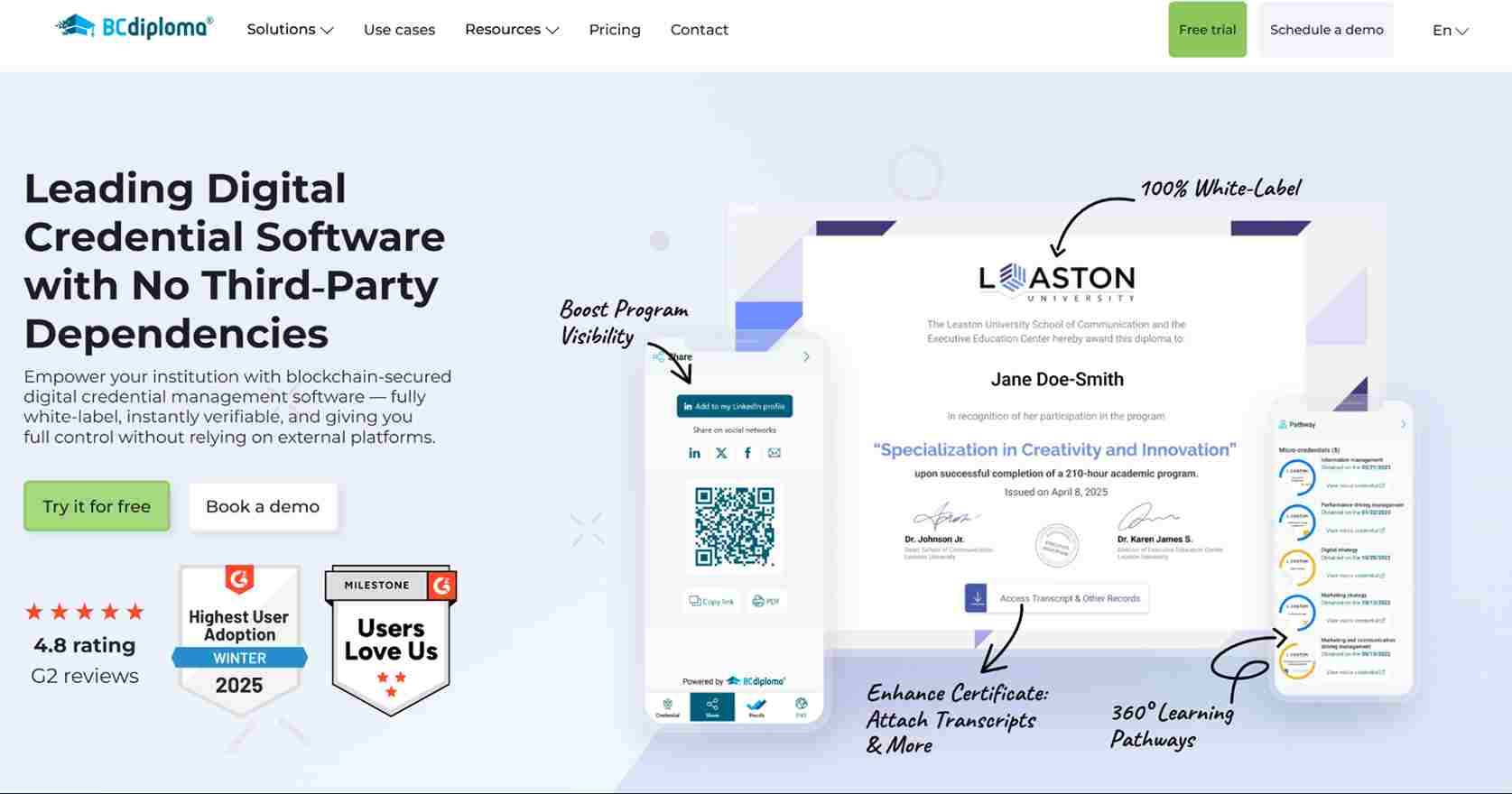
A white-label experience is available through the White Label Pack. Institutions can customize credential pages and use their own domains. The entry-level Essentials Pack offers standard customizable templates rather than the complete white-label setup.
BCdiploma also uses a patented cryptographic method to support GDPR’s right to erasure. Credential data can become permanently inaccessible when the relevant cryptographic key is deleted.
The Essentials Pack starts at $1.50 per recipient per year under its current promotional offer. A minimum of 200 recipients applies. White-label and unlimited plans use custom annual pricing.
Best higher-ed use case: formal diploma issuance and prestige credentials that demand institutional control and long-term verification.
Formerly Canvas Credentials, this product was rebranded as Parchment Digital Badges on October 31, 2025. It now belongs to the Parchment Award product family.
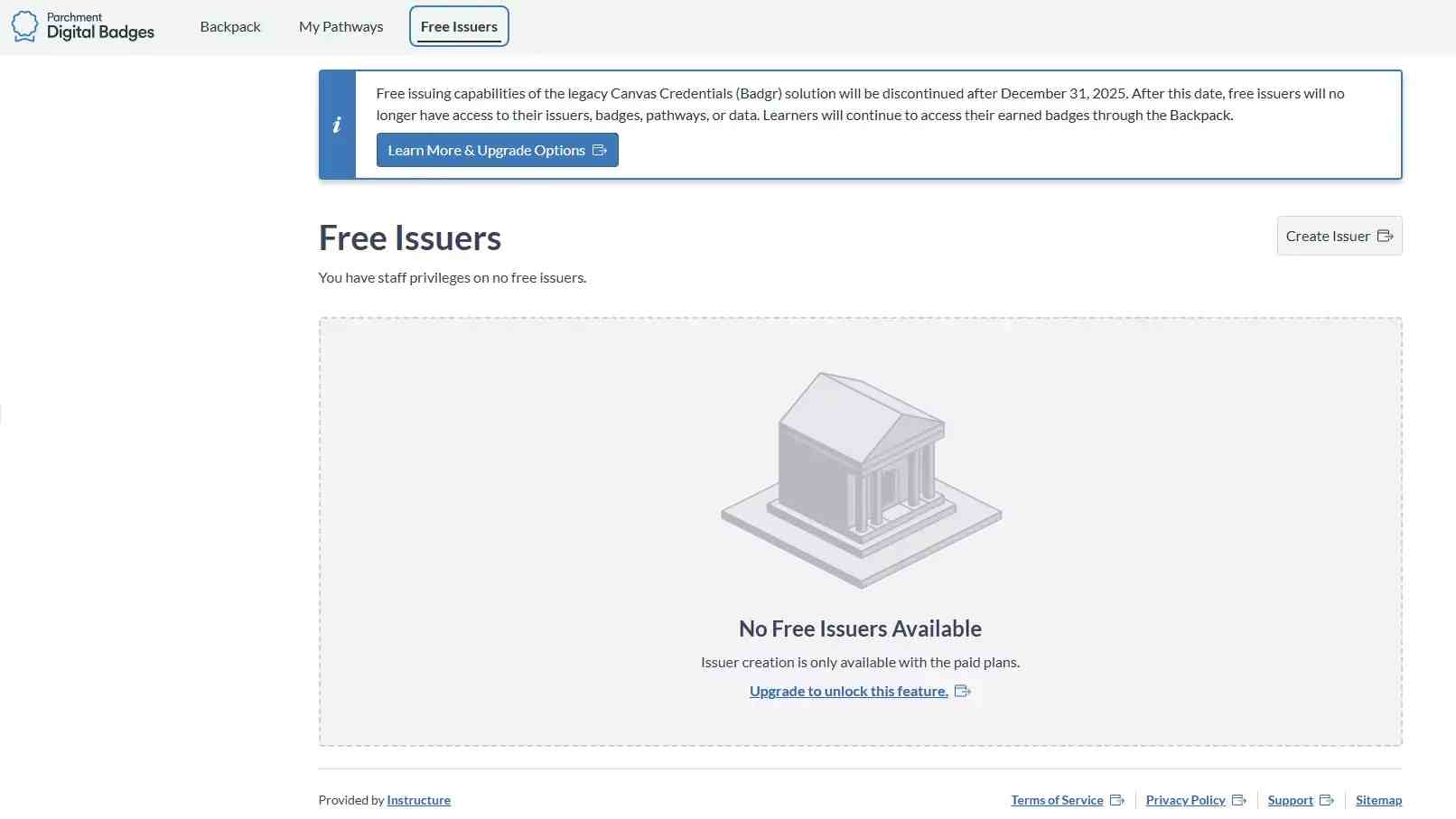
If your campus already uses Canvas, it is a natural fit because badges can be connected to course requirements or module completion. The exact awarding workflow depends on the course configuration.
It supports Open Badges and offers Open Badges 3.0 settings. Institutions can also build stackable pathways that connect multiple badges into a structured learning sequence. Embedded labor-market data links credentials to relevant job roles and salary benchmarks.
Parchment offers Comprehensive Learner Record services as a separate part of its wider credential ecosystem. The platform is not limited to Canvas, since it also supports other LMS connections.
However, Canvas institutions may get the most direct link between course progress and badge issuance.
Best higher-ed use case: Canvas-based institutions that want badging built directly into existing course workflows.
The fastest way to a defensible shortlist is to start from the credential you're actually issuing, not from the longest feature list. Match the job to the platform:
Microcredentials and continuing education: Certifier
Formal degrees with blockchain trust and EU compliance: BCdiploma
Large institution prioritizing an employer network: Credly
Mid-size, LMS-automated certificate programs: Accredible
Canvas-native institution: Parchment Digital Badges
Most evaluations also come down to two practical filters: how the platform connects to your LMS and whether its pricing and contract terms fit how you actually issue.
The top digital credential platforms for higher education now all issue verifiable credentials under Open Badges 3.0, so that's table stakes rather than a differentiator.
What separates them is procurement weight and cost transparency, which is why generic digital credential management software often loses to a tool built for the higher-ed workflow.
If your programs sit in the microcredential and continuing-education space, where flexibility and clear pricing matter most, Certifier is the easiest to justify internally. Explore Certifier for higher education.
It handles microcredentials in higher education and digital badges in higher education on the same plan, so you can start a free batch in no time, then scale only when your cohorts grow.

- SaaS Growth
- Digital Credentials
- APIs
- Product Marketing
- Company Operations
CEO and Co-Founder
Sergey is CEO and Co-Founder of Certifier, a Forbes 30 Under 30 honoree building digital credential infrastructure for 2,000+ organizations worldwide and shaping the future of credentialing.
Certifier Pricing
https://certifier.io/pricingCertifier Integrations
https://certifier.io/integrationsCredly by Pearson Platform
https://info.credly.comCredly by Pearson Pricing
https://info.credly.com/pricingAccredible Pricing
https://www.accredible.com/pricingBCdiploma Pricing
https://www.bcdiploma.com/pricingModernCampus; Microcredentials Move from Innovation to Imperative for Higher Education
https://moderncampus.com/newsroom/microcredentials-move-from-innovation-to-imperative-for-higher-education



 Most popular