

Trusted by:
University of Southern California
Warner Bros.
Volvo
Amazon
Stanford University
Updated: August 21, 2026
8 min read
Not every learning path moves retention. This guide shows what separates generic training from pathways with career movement, milestone credentials, and measurable impact.
Research with AI:
88% of organizations are concerned about employee retention, and LinkedIn’s 2025 Workplace Learning Report names providing learning opportunities as the top retention strategy.
That puts pressure on HR and L&D teams to turn training into something employees can see value in. But not every learning path moves retention. The design matters.
Learning paths for employees produce different results when they connect to a named career outcome, recognize progress before the final step, and make credentials visible beyond the LMS.
This article gives you the evidence, four design principles, a pre-launch diagnostic, and measurement guidance for building pathways with retention in mind.
Learning paths drive retention only when they meet specific design conditions–most programs miss these.
Four design principles separate retention-driving pathways from generic L&D–career-line visibility, recognized progress at meaningful intervals, aspiration-fit, and portable credentials.
Use the pre-launch checklist to test if your current setup is built to retain.
Completion rate alone doesn't prove a pathway is moving retention–the metrics that do are different.

Learning paths for employees move retention under specific design conditions. The number of modules, the content quality, and the platform are secondary variables. The primary variables are the pathway’s ability to create visible career movement and the portability of the credentials employees earn.
The table below maps the five design differences that separate retention-driving employee development programs from generic L&D.
Design Element | Retentiondriving Learning Path | Generic Ld |
|---|---|---|
Career connection | Connects to a named next role, level, or capability | Covers skills with no career-line context |
Progress recognition | Credentials issued at meaningful intervals mid-journey | Recognition at course completion only |
Input source | Based on what employees want to become | Built around org-defined skill gaps only |
Credential portability | Shareable outside the LMS–on LinkedIn, in performance reviews | Lives in the LMS admin view and stops there |
Manager visibility | Progress is visible to managers in the tools they open weekly | Visible only to LMS admin |
Each of the four design principles in the next section corresponds to one or more rows in the left column.
For a clear definitional anchor before you go deeper, read our guide on what a learning pathway actually is.
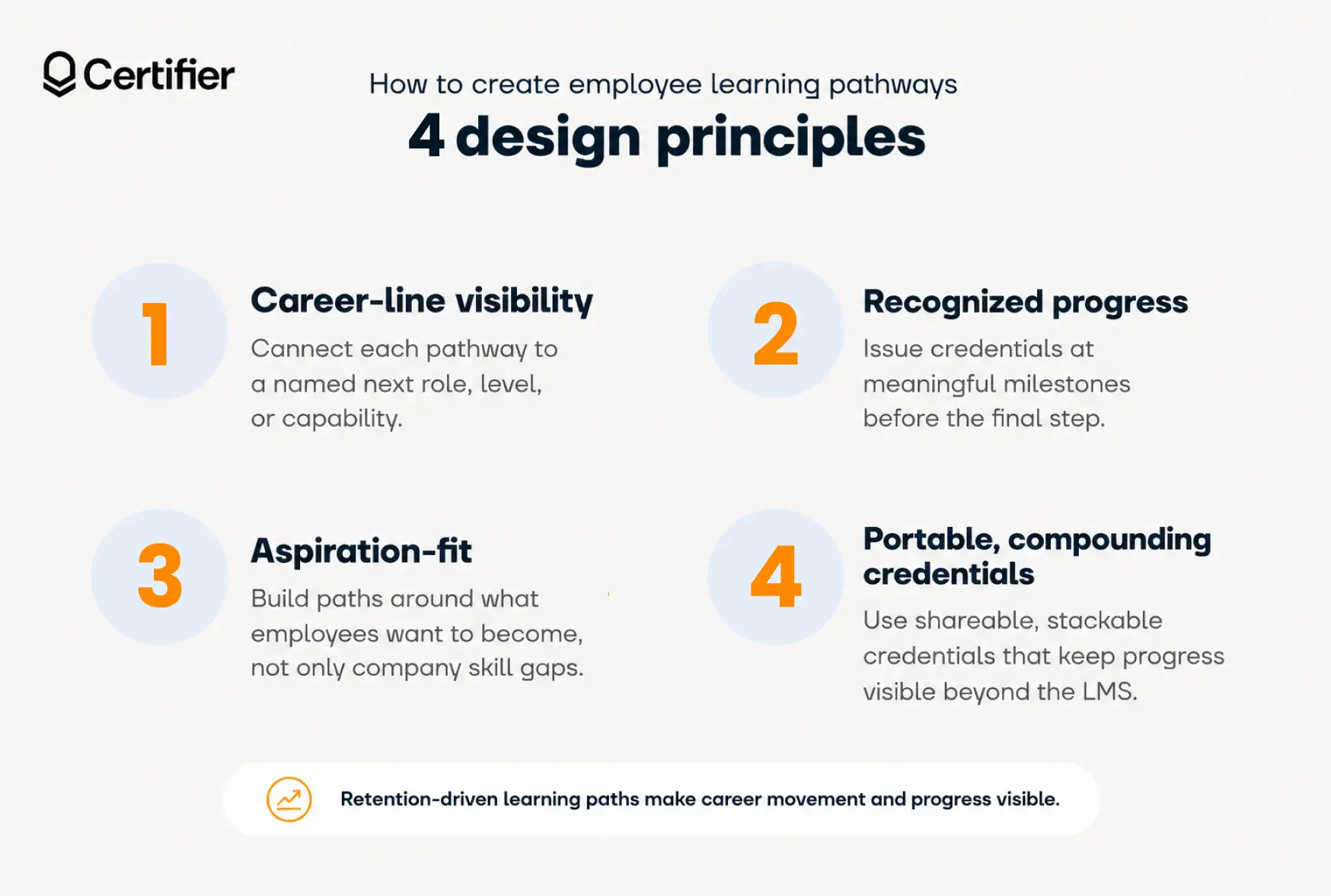
When creating learning paths for employees, these four principles need to be built in before the first credential is issued. Each one ties to a specific retention mechanism supported by research.
If learners lose momentum before they see progress, the pathway starts to behave like standard training. That is why employee engagement during training matters inside the design, not only after launch.
A learning and development career path must connect to a named next state: a role, a level, or a defined capability. "Complete this path to qualify for first-time-manager roles" functions as a retention mechanism. A standalone leadership course covering identical content doesn’t, because it creates no psychological commitment to staying.
Employees stay when they can see where the current work is taking them. Leaving before completing a named pathway means abandoning documented progress toward a specific outcome.
Without that career-line context, an employee who finishes the program has no reason tied to it to remain.
Learning pathways for employees with credentials only at the final step leave the entire mid-journey period unrecognized. For a 12-module program, that's months of effort with no visible signal that the organization acknowledges the employee's progress.
Mid-journey credential issuance changes that. A credential issued after step three of seven tells the employee, and their manager, that progress is being tracked as it happens, not only at the end.
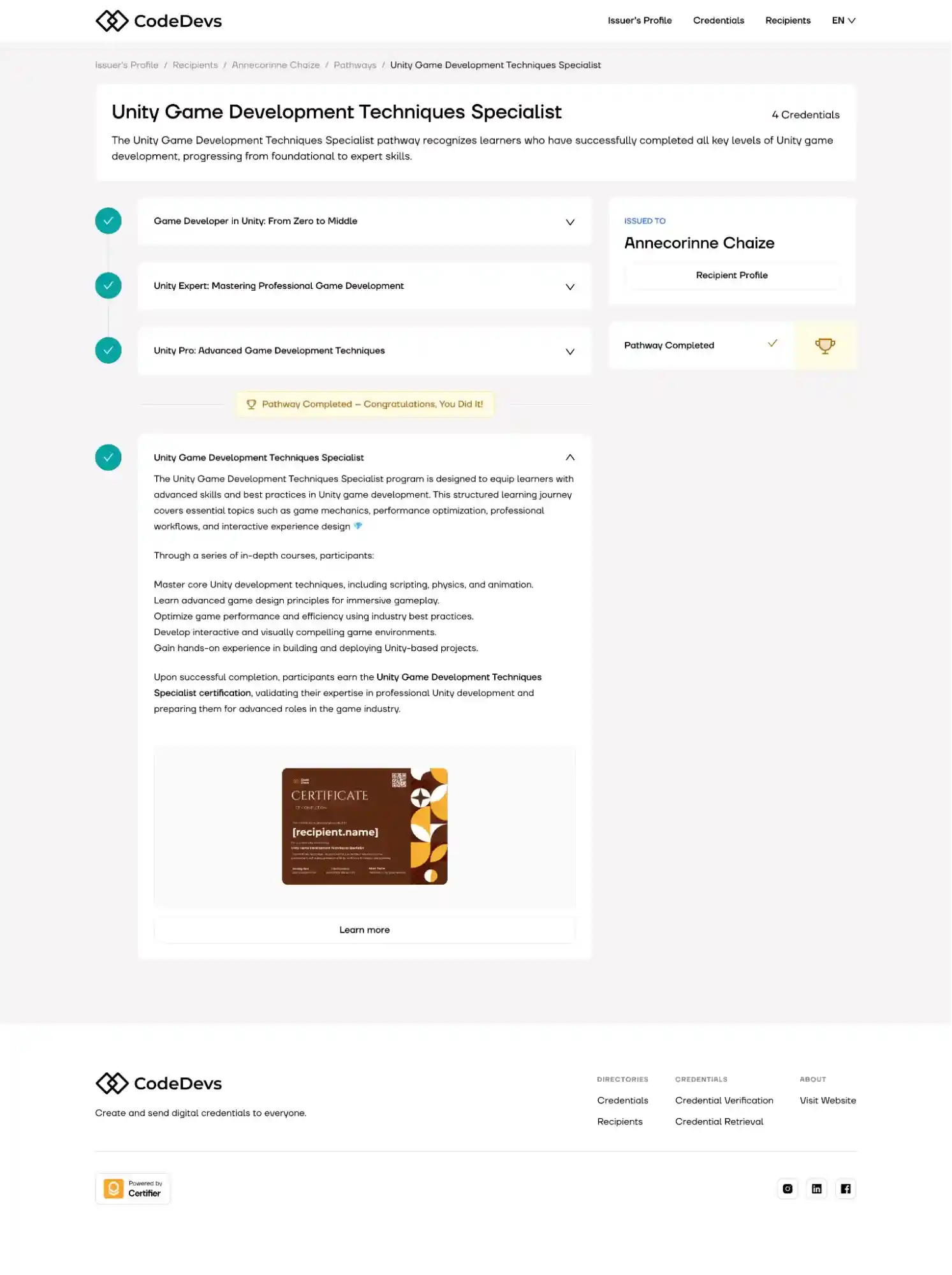
Certifier Pathways implements this at the infrastructure level: criteria credentials are defined at each step, issuance is automated when conditions are met, and progress indicators are visible on the employee's recipient profile, the issuer's portal, and the credentials directory.
The employee can see their position on the pathway in real time without checking a separate system.
 Certifier Pathways
Employee development programs built exclusively around org skill gaps produce lower retention results than programs that incorporate what employees want to become.
A pathway that addresses the organization's skill inventory signals to the employee that the investment is for the company's benefit. A pathway that also maps to the employee's stated career aspirations signals that the investment is for theirs.
Aspiration-fit doesn't require individualized programs for every employee. It requires asking what employees want–through surveys, manager conversations, or development planning sessions–then offering pathways that match, even if the options are a defined set of tracks.
Credentials that live only in the LMS produce weaker retention results than credentials employees can share externally, reuse in performance reviews, and stack toward broader qualifications.

A shareable digital badge: LinkedIn post
Microcredentials and stackable credentials that accumulate across a learning pathway become part of an employee's professional identity over time.
An employee who has earned five verified step credentials in a named pathway has built something with professional value outside the organization. The further along the pathway, the more that record compounds–which raises the cost, to the employee, of leaving mid-program.
MIT xPRO cites the outcome: employees with access to workplace learning are 15% more engaged and have 34% higher retention. Credential portability extends that effect by giving employees something durable to show for their development investment.
Run these six checks before activating a new employee learning path or auditing an existing one. Each item tests if the four design principles are in the program's structure, not just in its documentation.

An employee can name the role, level, or capability the pathway leads to without consulting a separate document.
An employee can answer "where am I in this pathway?" in under 30 seconds.
At least one credential is issued before the final step, with the trigger for issuance documented.
You can point to a specific input–survey response, manager conversation, or development interview–that shaped the pathway's content.
At least one earned credential is visible outside the LMS: on a LinkedIn profile, in an internal directory, or in an HRIS record.
A direct manager can locate a report's pathway progress in a tool they open on a weekly basis.
If any item requires an explanation rather than a demonstration, the design condition isn't met. The pathway needs revision before launch.
Completion rate measures whether employees finished the program. Engagement scores measure participation. Both are useful for program management. Neither answers whether learning paths for employees are moving the retention metric.
Tip: Before measuring progression through a pathway, make sure participation data is complete. This modern red training attendance sheet gives program managers a simple record of who attended each session, helping them distinguish non-attendance from a learning or engagement problem.
Retention-specific metrics require a comparison cohort. Establish a baseline before the program launches. Without one, there's no way to isolate the pathway as the variable.
Retention rate, participants vs. non-participants. Compare the 12-month retention rate of pathway participants against a comparable cohort that didn't enroll. This is the primary metric for any employee development program claiming a retention outcome.
Per-step completion rate. A pathway with strong enrollment but heavy drop-off at step two has a design problem. Identify where learners stall, because that's where the retention benefit stalls too.
Time-to-credential. Track how long participants take to earn each step credential. Steps completed too quickly suggest the criteria are too easy to represent real progress; steps taking significantly longer than expected suggest they're blocking momentum.
Internal mobility rate from pathway completers. The percentage of completers who move to a new role, level, or function within 12 months is the strongest leading indicator of whether the pathway is generating career movement. Programs that generate certificates without generating mobility won't sustain retention impact over time.
Credential share rate. Low share rates indicate the credential lacks perceived external value. Address credential design and portability before scaling the program.
Time-to-promotion for completers vs. non-participants. This metric takes 12–24 months to produce meaningful data, but it's the most defensible number for a leadership conversation about program ROI.
Generating these metrics requires a credentialing layer that records who earned which credential, at which step, and when. Without step-level data, the only available number is overall completion rate.
Certifier Pathways records per-step recipient counts, issuance timing, and drop-off points in the pathway analytics view. Combined with HRIS retention data, those inputs let you measure whether your employee development program is producing the outcome it was designed for.

Certifier's Pathways analytics
Certifier helps track progress and issue credentials throughout employee learning paths. It does not create the course content. It does not replace your LMS or act as the HRIS. It gives the pathway a visible credential structure.
Employees earn verified credentials at defined steps, so progress appears before the final certificate. They can also see where they stand in the pathway as they move through it.
After each milestone, they receive credentials they can use outside the company, including on a LinkedIn profile, in a performance review, or in an internal job application.
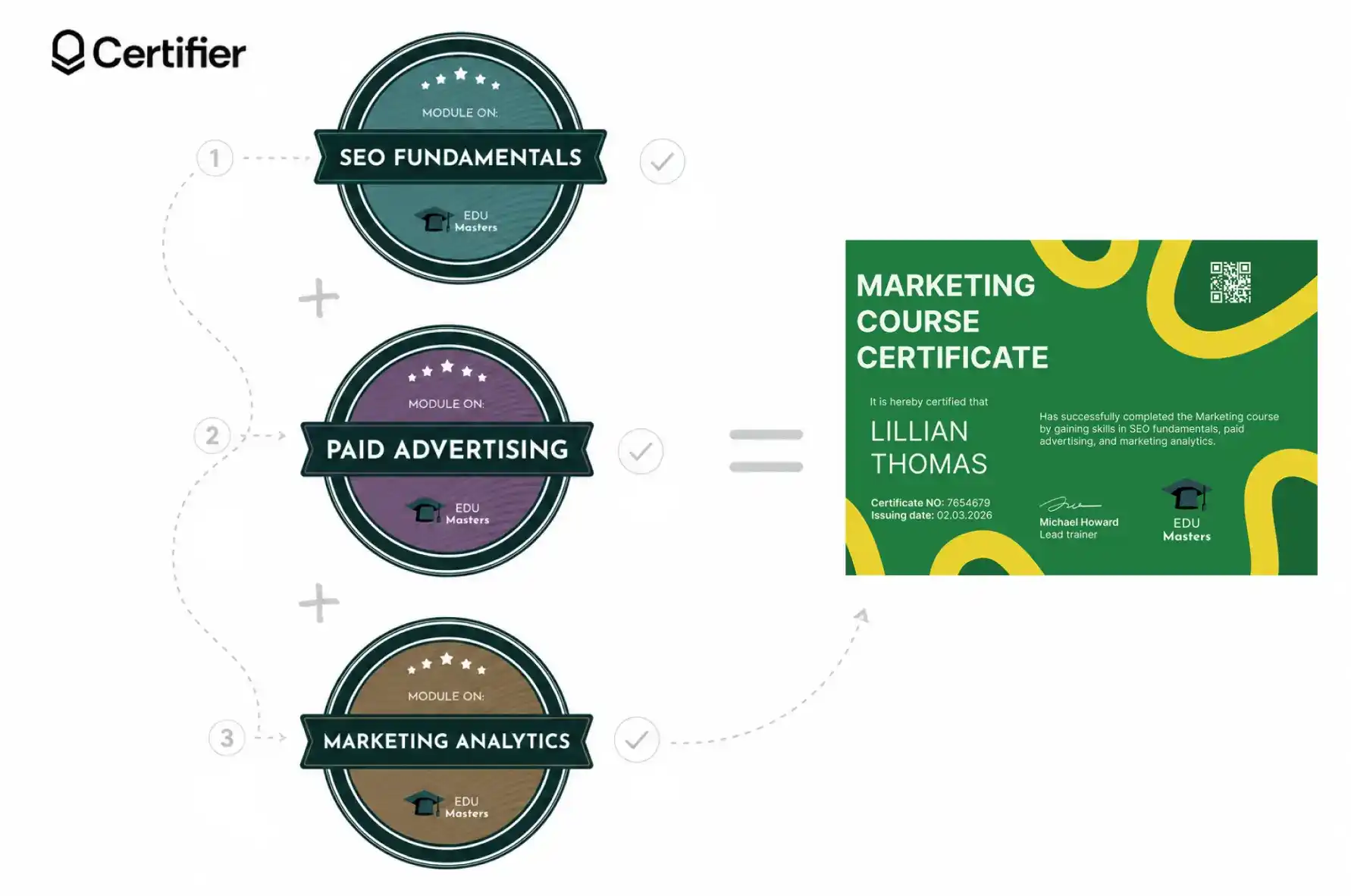
Credentials employee can receive during learning and development career path
Credentials that employees can put on a LinkedIn profile, reference in a performance review, or stack toward a formal qualification become part of their professional record. The further along the learning pathway, the more compounds are recorded.
An HRIS tracks whether someone stays. Certifier provides the step-level credential data that tells you what's driving that outcome or surfaces the missing recognition that explains the gap.
Your HR system remains the source of truth for retention metrics. Certifier feeds it the step-level credentialing data it needs to answer the retention question.
Start building your learning pathway with Certifier–free to start, no setup fee.
A learning path moves retention when employees can see where it leads, feel progress before the final step, and leave with proof that has value beyond the LMS.
Pathways that do not create that visible career movement may still support training goals, but they are less likely to become the reason someone stays.
Start by designing for retention. Learn the full process in our step-by-step guide to building a learning pathway.

- Content Writing
- On-page SEO
- Localization
- Market Research
- Keyword Research
Content Specialist
Daria creates practical guides and templates that help training providers, educators, and event organizers solve digital credentialing challenges.
LinkedIn Learning – Workplace Learning Report 2025
https://learning.linkedin.com/resources/workplace-learning-reportMIT xPRO – HR Trend Report: Education Perks Are Critical to Today’s Workers
https://curve.mit.edu/hr-trend-report-education-perksGallup – The Benefits of Employee Engagement
https://www.gallup.com/workplace/236927/employee-engagement-drives-growth.aspx


